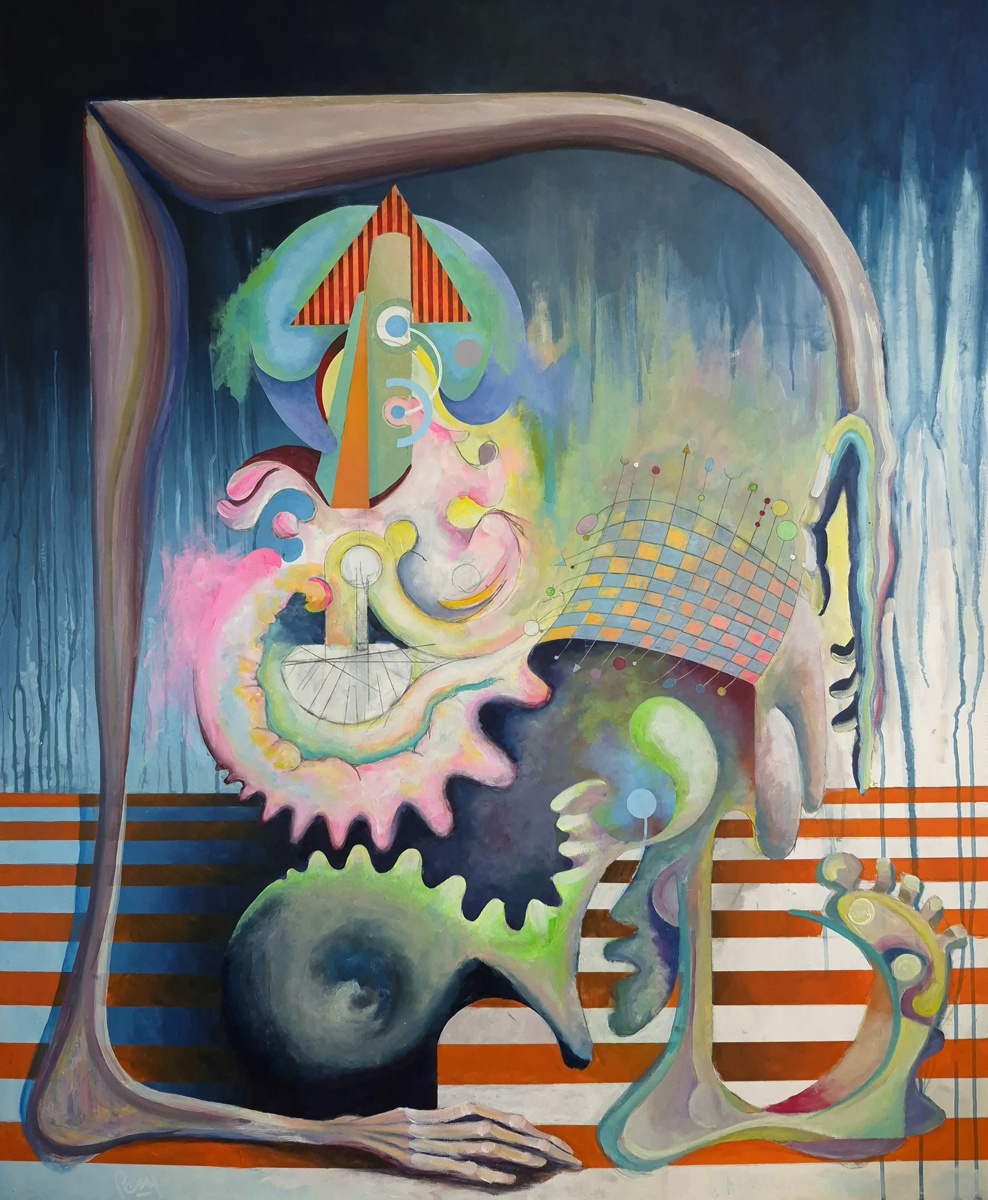
The Catastrophic Tic Toxic Engine.
My work explores Psychological Cubism; the fragmentation of identity under pressure. Not the pressure of war or industry that shaped early Modernism, but the quieter, more persistent pressures of contemporary life. The endless stream of information, comparison, performance and distraction that now competes for our attention.
The Catastrophic Tic Toxic Engine examines what happens when these external systems become internal ones.
The figure is constructed from competing signals: fragments of thought, memory, desire, anxiety and expectation. It exists somewhere between a portrait and a machine. Within its architecture, information circulates continuously, looping back on itself, accelerating as it travels. What begins as curiosity becomes comparison. Comparison becomes dissatisfaction. Dissatisfaction becomes habit.
The work considers a condition many of us recognise but rarely acknowledge; the gradual outsourcing of self-worth to systems designed to keep us engaged. We scroll in search of connection and leave with a heightened awareness of everything we are not. We consume endless representations of life while becoming increasingly absent from our own.
At the centre of the composition, a dark spiral form is held delicately, almost protectively. It is unclear whether the figure is nurturing the object or being burdened by it. That ambiguity is intentional. The things that exhaust us are often the very things we struggle to put down.
The engine is catastrophic not because it fails, but because it succeeds. It does exactly what it was built to do. It converts attention into dependency, distraction into routine and insecurity into perpetual motion.
Somewhere within the machinery, the individual remains convinced they are still making their own decisions.